
Bad Bunny’s Super Bowl Halftime Show: A Puerto Rican Declaration Wrapped in Celebration
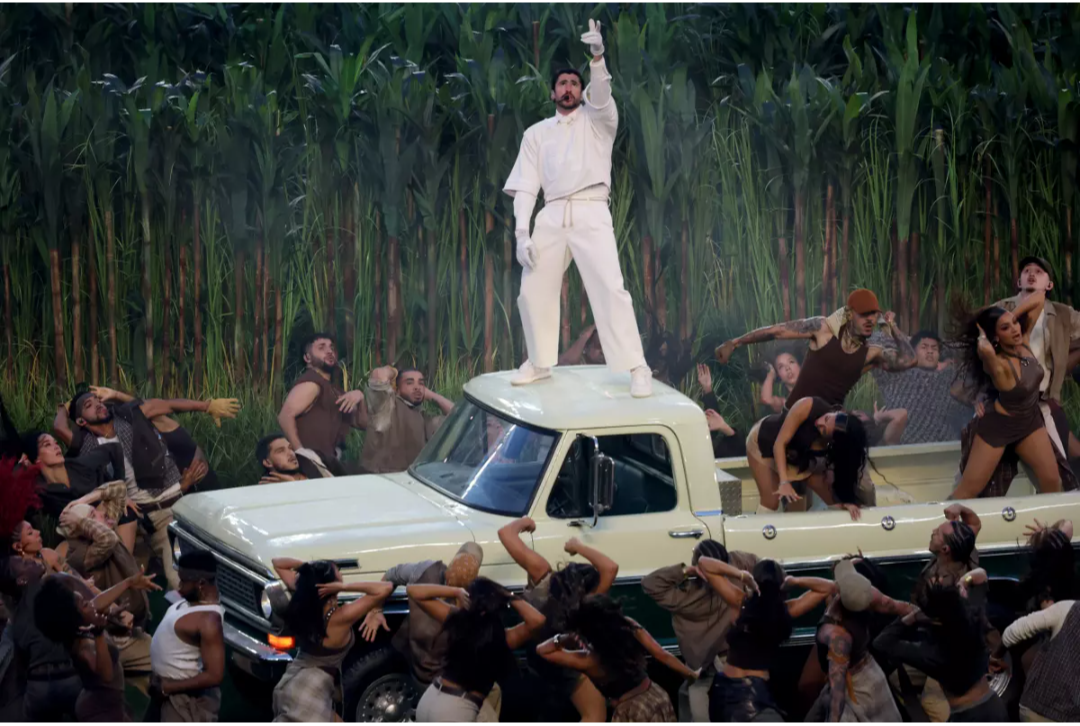
Bad Bunny on top of pickup truck during his Superbowl Halftime Show
The Super Bowl halftime show is typically designed to reassure America about itself. Big stars. Big lights. Clean spectacle. Safe patriotism. But Bad Bunny did something different.
Instead of presenting Puerto Rico as a backdrop for tourism or nostalgia, he presented it as a living people, a colonized territory, a diaspora, and a culture that refuses erasure. What looked like a joyful, colorful party on the surface was, underneath, a layered meditation on history, belonging, and survival.
This was not simply a halftime show. It was a moving portrait of Puerto Rican life, stitched together with politics, memory, and resistance.
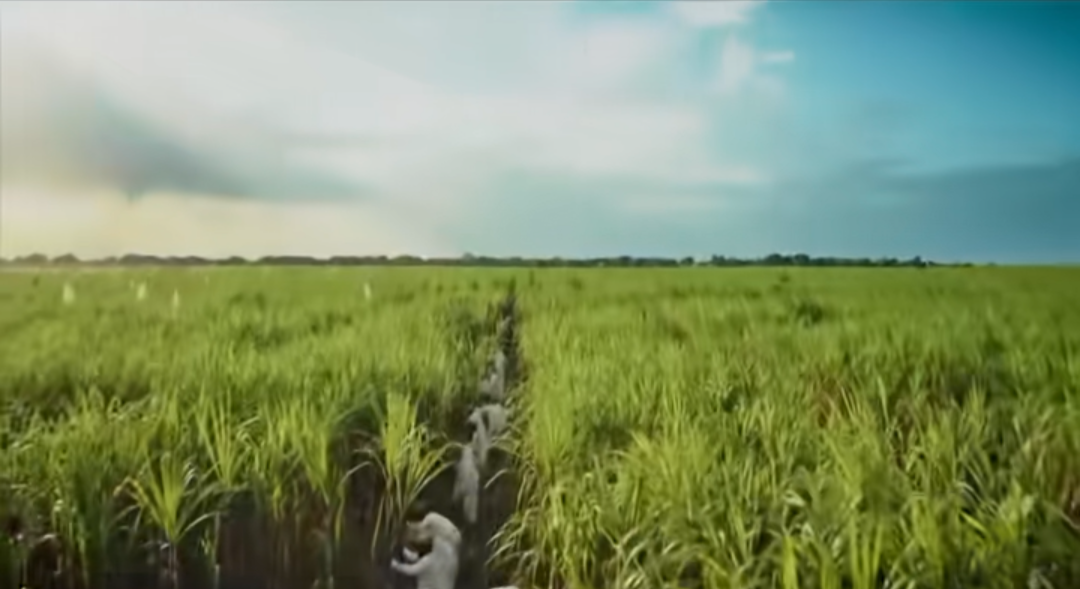
Sugarcane fields in Puerto Rico
From Sugarcane Fields to Everyday Life
The performance began in the sugarcane fields of Puerto Rico, immediately centering a landscape tied to slavery, colonial extraction, and economic exploitation. Before any celebrity, before any stadium lights, we were grounded in land that has long been worked, taken from, and fought over.
From there, the camera moved through scenes of ordinary Puerto Rican life:
A man selling coco frío
Older tíos playing dominoes
A young woman getting her nails done
Women loading cement blocks
A piraguas cart displaying flags from across Latin America
Villa’s Tacos stand
Two boxers, one from Puerto Rico and one from Mexico
None of this felt random. Together, these images insisted that Puerto Rican culture is not just music and beaches, but labor, community, migration, and shared Latin American identity.
It was a collage of a living people, not a postcard.
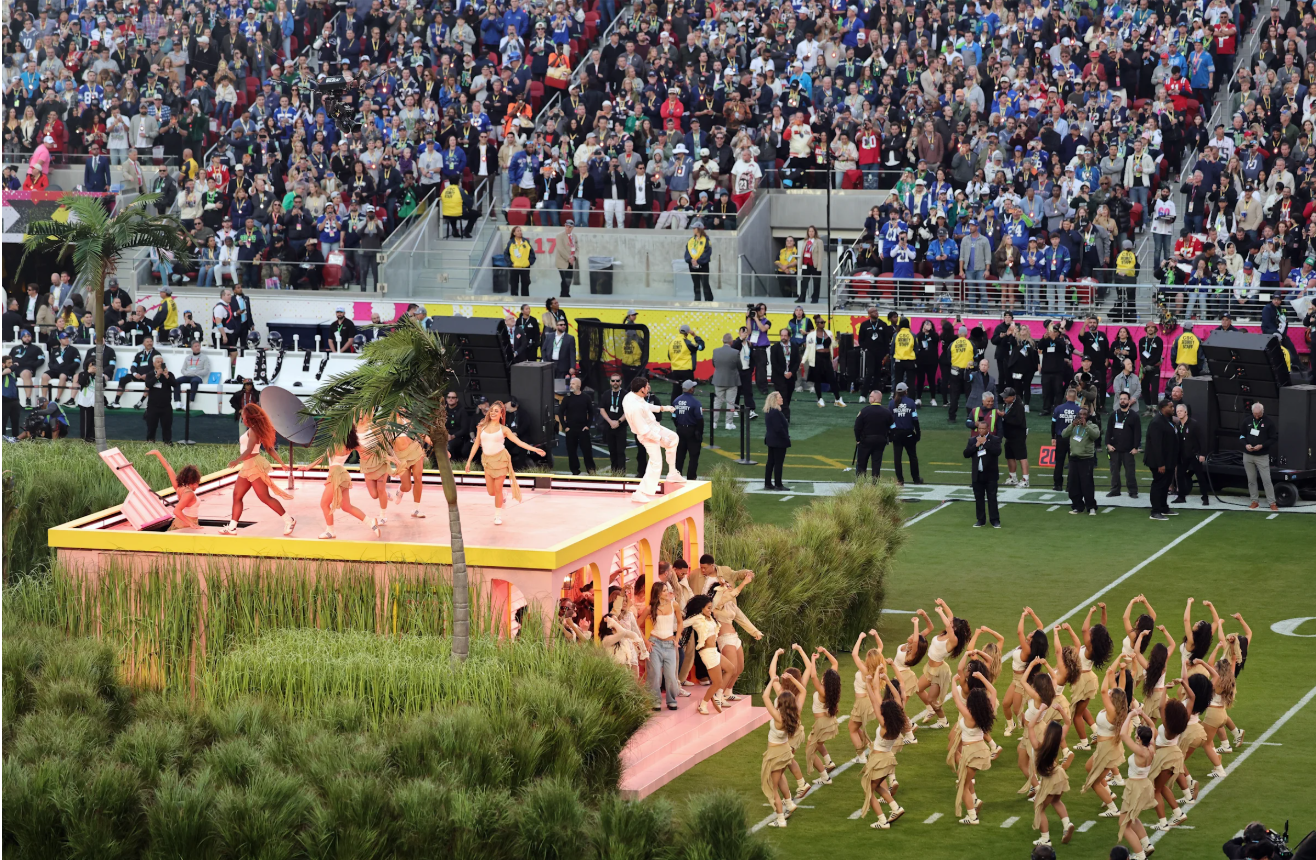
Bad Bunny performing La Casita
Love, Work, and Community
In a tender moment, Bad Bunny buys a wedding ring from a jewelry salesman at Compro Oro y Plato and hands it to a young couple. The man drops to one knee and proposes, turning the everyday act of buying gold into a moment of collective joy.
Immediately, the scene shifts to a house party in front of a classic Puerto Rican-style home. Dancers fill the yard, Puerto Rican celebrities mingle in the background, and Bad Bunny performs on the roof before dramatically crashing through it onto a family dinner table.
Instead of chaos, he walks out and continues celebrating. The message felt clear: even when the roof falls in, life continues.
Then the party spills back into the sugarcane fields, where a diverse group of young Latinos dance around a vintage green-and-white pickup truck. Bad Bunny climbs atop it, urging them to move, laugh, and celebrate themselves.
Here, joy becomes resistance.
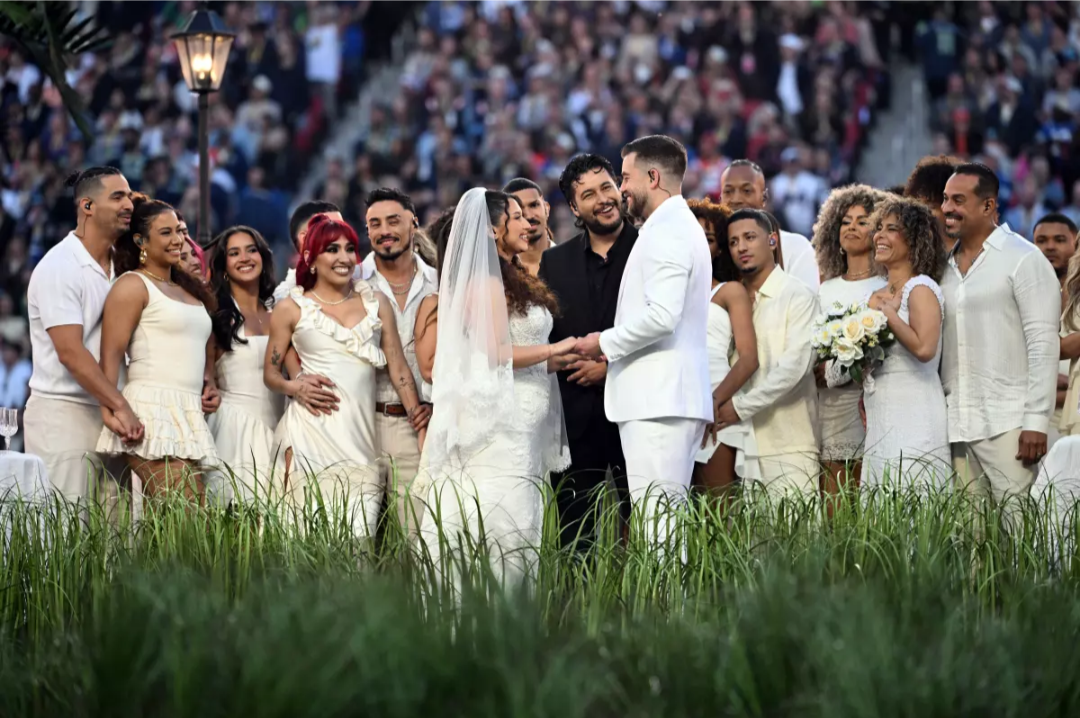
Couple getting married during halftime show
A Real Wedding on the World’s Biggest Stage
The camera then pans to an actual wedding ceremony taking place at halftime.
This couple, who reportedly got engaged at a Bad Bunny concert, are married live on national television. After they kiss, the scene transforms into a full reception: dancing, children running around, and even a sleepy kid stretched across chairs that Bad Bunny gently wakes up.
The joy feels real because it is real. The Super Bowl becomes a community celebration, not a corporate production.
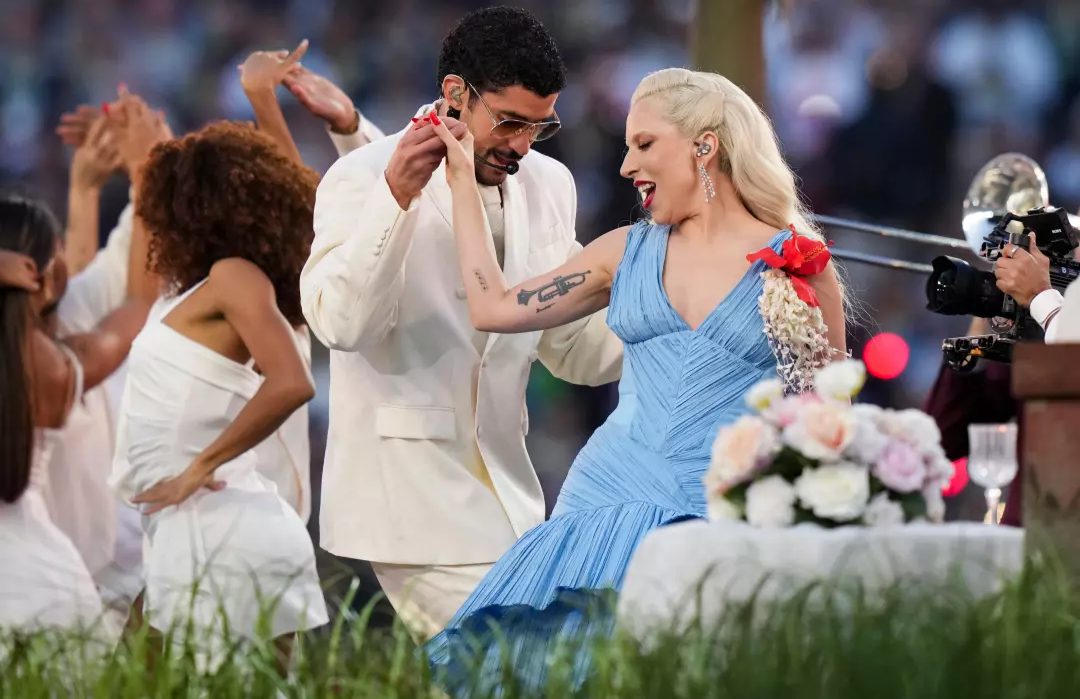
Bad Bunny and Lady Gaga dancing the salsa
Lady Gaga: The “American” Bridge and a Flag in Disguise
After the wedding kiss, the tone shifts again with the arrival of Lady Gaga.
She steps onto the stage to sing part of “Die With a Smile,” a song she co-wrote with Bruno Mars, who is himself Puerto Rican. On the surface, this looks like a glamorous pop interlude. Beneath it, the symbolism is sharp.
Up to this point, the entire halftime show had been performed in Spanish. This was a deliberate choice in a space that almost always centers English. Gaga’s appearance therefore functions as a cultural bridge, but not in the way critics likely expected.
Many viewers read her inclusion as a playful rebuttal to conservative backlash over Bad Bunny headlining the Super Bowl. Critics had insisted that an “American” artist should perform, even though Puerto Rico is a U.S. territory. In response, Gaga appears: blonde, white, singing in English, and unmistakably part of mainstream American pop culture.
Yet she does not dominate the stage. Instead, she dances salsa with Bad Bunny, entering his world rather than pulling him into hers.
Even her styling feels intentional. Gaga wears a baby-blue dress, the same shade as the original Puerto Rican flag, and a bright red rose in her platinum hair. Visually, she resembles the Puerto Rican flag itself.
Rather than symbolizing American dominance, she appears as a guest honoring Puerto Rico’s aesthetic, rhythm, and sovereignty.
After Gaga’s performance, the camera returns to the newly married couple, cutting their wedding cake. Children run through the reception, people dance, and Bad Bunny playfully wakes a sleeping child before finally falling backward off the roof into a waiting crowd of fans, a literal trust fall into his community.
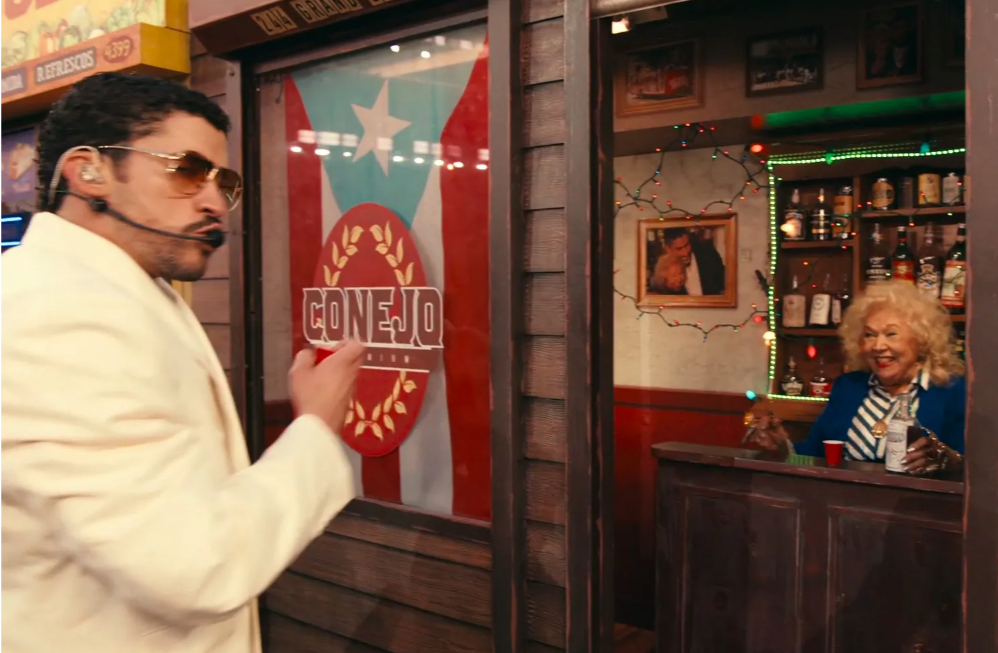
Bad Bunny taking a shot with Maria Antonia Cay, known as Toñita
Williamsburg, the Diaspora, and Tonita
The scene then shifts to Williamsburg, Brooklyn, outside a bodega and barbershop, an unmistakable homage to Puerto Rico’s deep roots in New York City.
Here, Bad Bunny takes a shot with Tonita, owner of the Caribbean Social Club, one of the last founding Puerto Rican establishments in a heavily gentrified neighborhood.
Tonita has resisted being pushed out for years. Her presence signals resistance to displacement, erasure, and cultural whitening of space. Sharing this moment with her is a statement of solidarity with Puerto Ricans fighting to remain in their own communities.
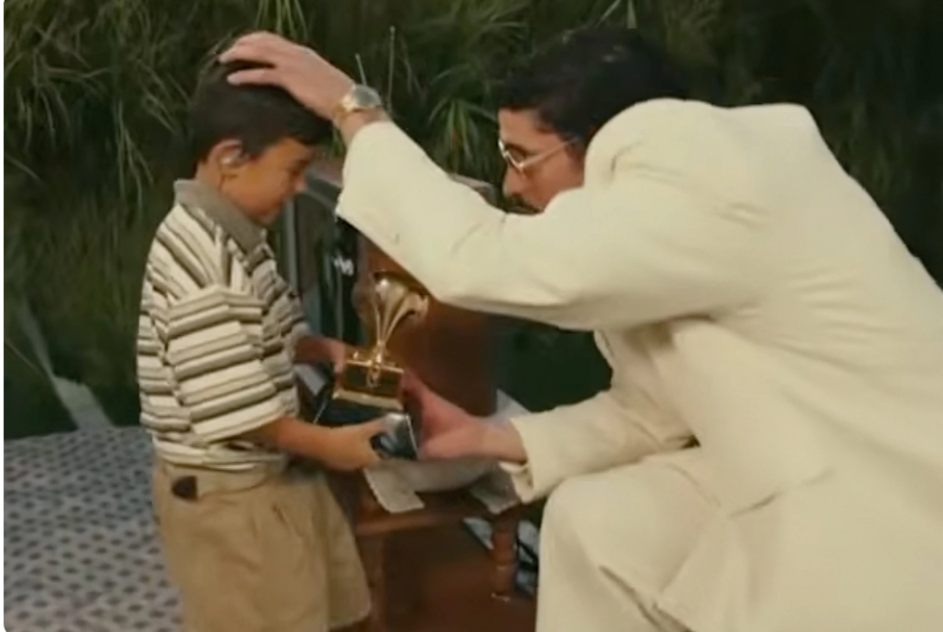
Bad Bunny gives young child his Grammy
Bad Bunny’s Grammy and His Younger Self
We then see a Puerto Rican family watching Bad Bunny accept Album of the Year at the Grammys.
Suddenly, the little boy stands up and is symbolically handed the Grammy by Bad Bunny himself. This scene reads as Bad Bunny giving the award to his younger self and to every child who looks like him, grew up like him, and dreamed like him.
It is legacy made visible.
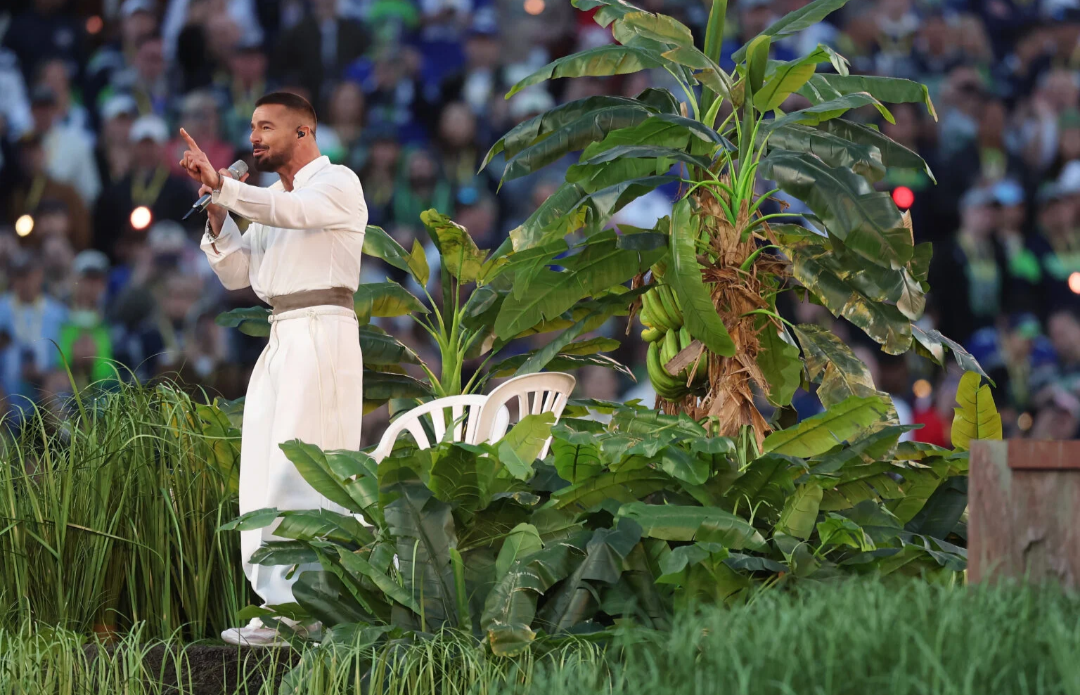
Ricky Martin guest performing during halftime show
Ricky Martin, Hawai’i, and Colonial Warnings
Ricky Martin appears sitting in iconic white plastic chairs, singing about how native Puerto Ricans are being priced out of their homes.
His lyric about not wanting Puerto Rico to become like Hawai’i functions as a sharp critique of U.S. colonial expansion, tourism, and displacement of Indigenous peoples.
This is one of the most explicitly political moments of the night.
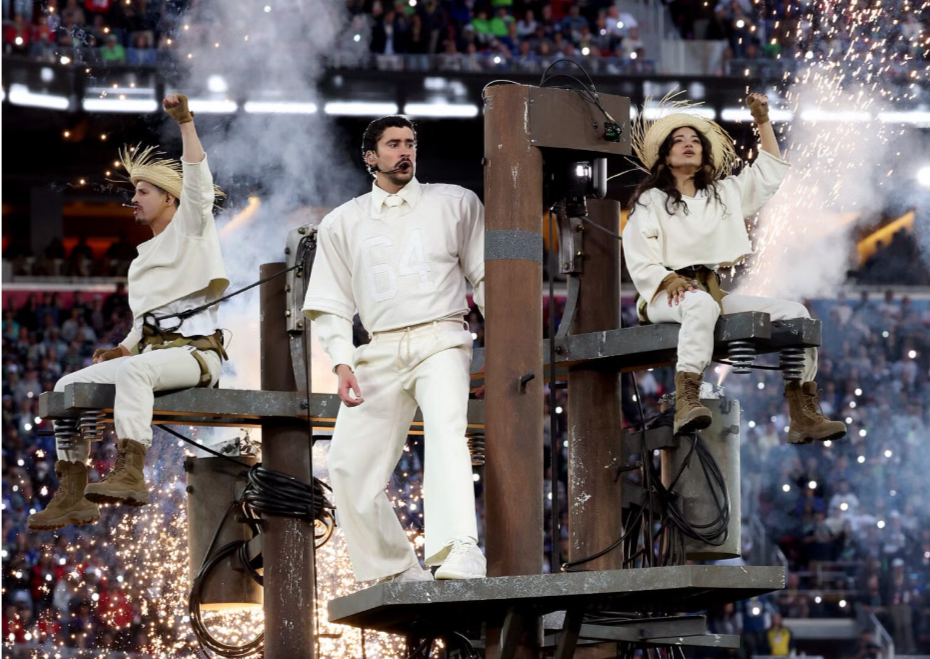
Bad Bunny standing on lightpole during a “power outage”
Power Outages and the Light Blue Flag
The stage then recreates a power outage, referencing Puerto Rico’s long-standing grid failures and the neglect following Hurricane Maria.
Amid the darkness, Bad Bunny walks forward carrying the original light blue Puerto Rican flag. This is significant because that version was once banned by the U.S. government.
By raising it, he reclaims Puerto Rican sovereignty and identity outside of American control. He declares that Puerto Rico is fine and will be fine, even in hardship.
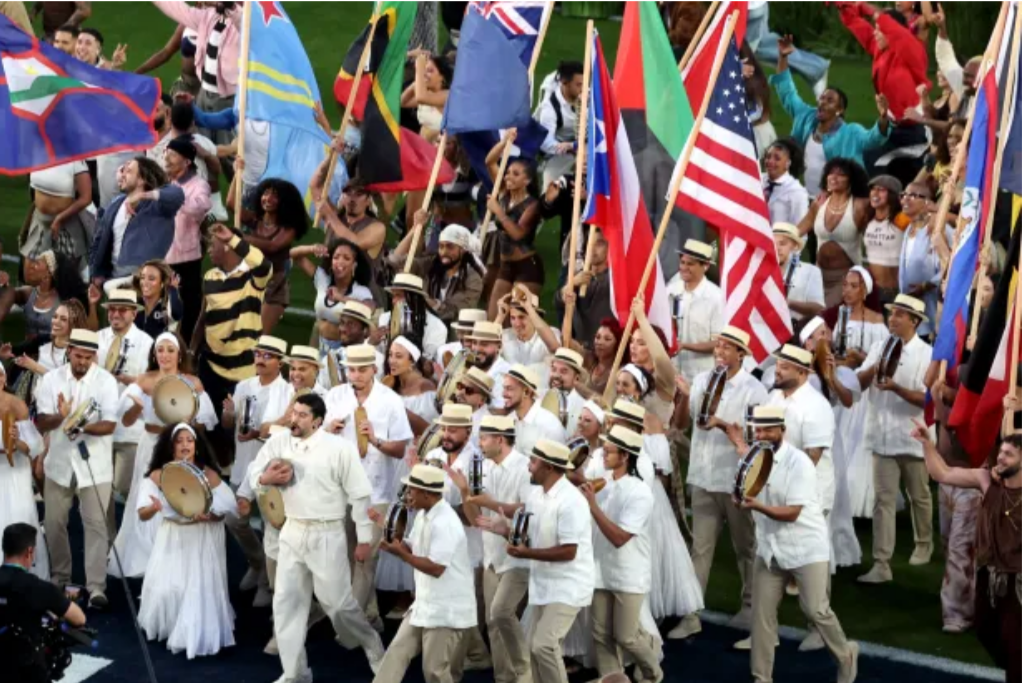
Diverse crowd of halftime show performers parade flags from North and South American countries
Unity, America, and “Seguimos Aquí”
In the final moment, Bad Bunny walks toward the camera holding a football that reads:
“Together, We Are America.”
Behind him, people wave flags from countries across both North and South America, calling for unity beyond borders.
He ends with the powerful words:
“Seguimos aquí.”
We are still here.
Despite colonialism, displacement, hurricanes, gentrification, and neglect, Puerto Ricans endure.
Final Thoughts: A Halftime Show That Refused the Script
Bad Bunny did not perform for America in the way halftime shows usually demand. He did not assimilate. He did not translate himself into palatable English. He did not hide Puerto Rico’s political reality.
Instead, he invited millions into a world of Boricua history, joy, struggle, and resilience.
This was celebration and protest at once. Party and memory. Pride and politics.
In a stadium built for spectacle, Bad Bunny delivered something rarer: truth.
Seguimos aquí.
What did you think of Bad Bunny’s halftime show? Let’s talk in the comments.
📢 Read more on Southern Geeky!
