
Mouse (2021) K-Drama Review: A Dark Psychological Thriller That Asks “Are Psychopaths Born or Made?”
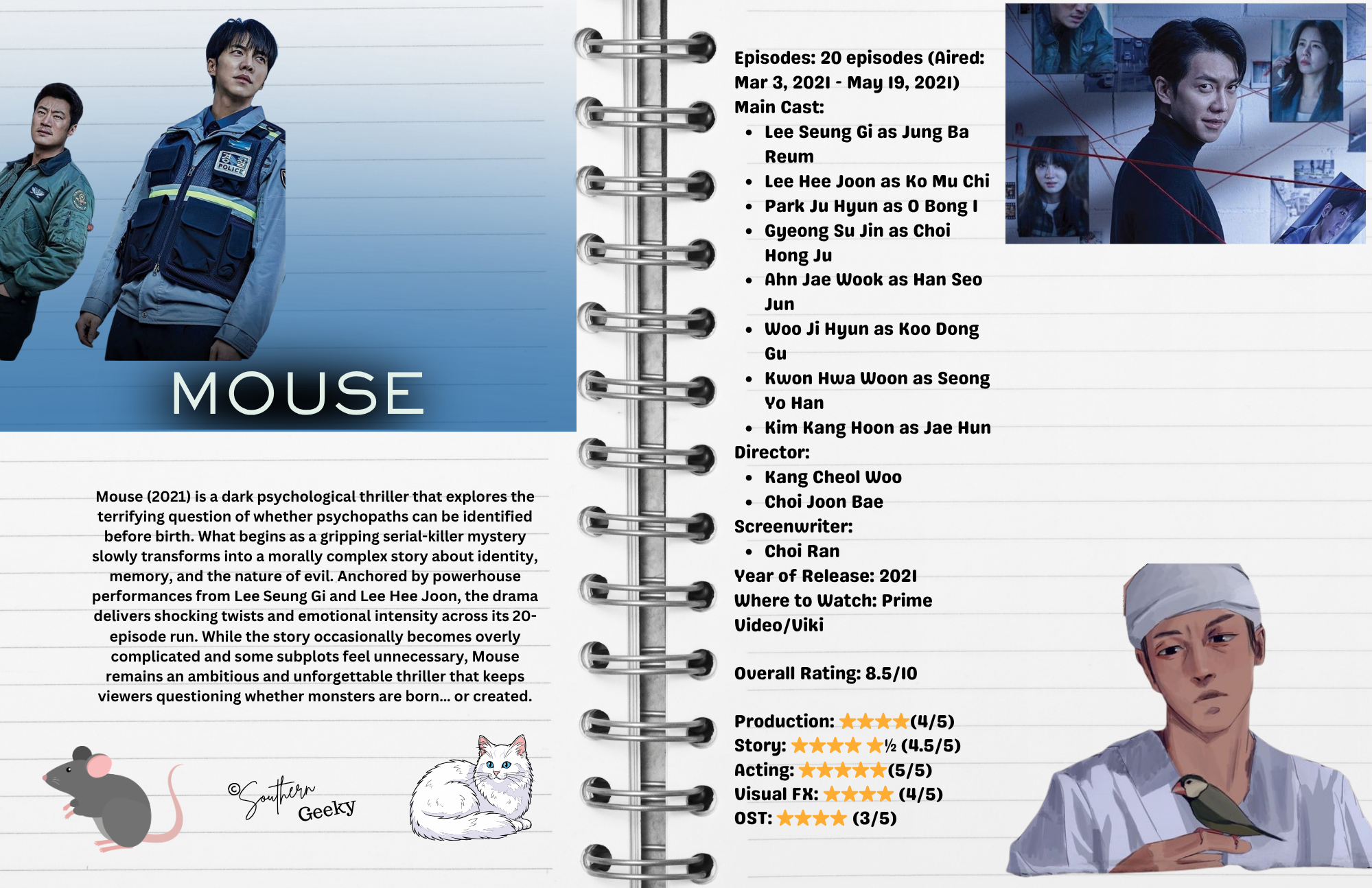
What if society could identify psychopaths before they ever committed a crime?
What if science gave us the ability to predict violence before it happened? And perhaps the most unsettling question of all: would we use that knowledge to prevent evil… or create even worse monsters?
The 2021 Korean thriller Mouse is built around that chilling premise. Airing on tvN and starring Lee Seung Gi and Lee Hee Joon, the drama begins as a gripping serial-killer mystery before evolving into something far more ambitious and chaotic. Over its 20 episodes, the series blends crime, psychological drama, moral philosophy, and unexpected science fiction elements into one of the most talked-about thrillers in recent K-drama history.
Going into the series, I had mixed feelings. I’m not usually a fan of Lee Seung Gi after watching him in the 2008 drama Shining Inheritance, where his character made several racist remarks about Black people. For a long time I had difficulty separating the actor from that role. Because of that, despite hearing years of hype surrounding Mouse, I initially avoided the drama.
However, after falling into a recent K-drama slump, I started watching shows outside my comfort zone, including ones I had intentionally skipped before. That finally led me to Mouse. And I have to admit something: Lee Seung Gi is a very good actor.
It is also fair to acknowledge that a lot of Asian media in the late 2000s leaned heavily on harmful stereotypes about Black people. That doesn’t excuse it, but it also doesn’t necessarily mean actors from that era personally share those views today. With that in mind, I approached Mouse with a more open perspective.
Story and Themes
At its core, Mouse explores a disturbing ethical dilemma: if we could identify psychopaths before birth, should we eliminate them?
The story follows rookie police officer Jung Ba Reum, who becomes entangled in a brutal series of murders terrorizing the nation. After surviving an encounter with a serial killer, Ba Reum’s life begins to change in unsettling ways. The investigation eventually intertwines with veteran detective Ko Mu Chi, whose own tragic past fuels his obsession with catching psychopaths.
What begins as a fairly straightforward whodunit crime thriller slowly transforms into something much bigger and stranger. Midway through the series, the narrative flips on its head and suddenly evolves into a story involving secret experiments, neurological manipulation, and moral questions about identity and humanity.
The tonal shift is dramatic. One moment you’re watching a traditional serial killer investigation, and the next the story dives into conspiracies involving illegal human experimentation and the question of whether a person can change their nature.
Even though I already knew the major twist before watching the drama, the storytelling still kept me entertained throughout most of the series.
One storyline that initially frustrated me was the brain transplant arc. At first it seemed like the show was implying that Jung Ba Reum was experiencing memories belonging to another character, Seong Yo Han. Thankfully, the story eventually clarifies that those memories are actually Ba Reum’s own, which made the twist far more satisfying.
Performances
The acting in Mouse is one of the drama’s strongest elements.
Both Lee Seung Gi and Lee Hee Joon absolutely acted their butts off in this series.
Lee Seung Gi delivers a layered performance as Jung Ba Reum, gradually shifting from a cheerful and naive rookie officer into something far darker and morally complicated. His transformation is unsettling in the best way and anchors the emotional weight of the story.
Lee Hee Joon is equally compelling as Ko Mu Chi, a detective fueled by trauma and revenge. His intensity brings urgency to the investigation and gives the drama its emotional backbone.
The supporting cast also deserves recognition. From the homicide detectives to the mothers and grandmothers caught in the tragedy, nearly every actor delivers convincing performances. The show also features excellent child actors, particularly in some of the most emotionally devastating scenes.
Direction and Production
Directors Kang Cheol Woo and Choi Joon Bae create a dark, tense atmosphere that suits the story’s psychological themes. The series frequently uses bleak color palettes, eerie lighting, and tight camera work to build suspense.
However, the production occasionally struggles with its own ambition. The show constantly introduces new plot twists, secret organizations, and hidden motives. While this keeps viewers guessing, it can also make the story feel overstuffed and convoluted at times.
Still, the pacing generally remains engaging, and the drama rarely becomes boring despite its complicated plot..
Strengths
Powerful performances
Lee Seung Gi and Lee Hee Joon deliver career-defining performances that carry the emotional and psychological weight of the series.Bold storytelling
The drama isn’t afraid to take risks. Its willingness to shift genres and challenge moral assumptions makes it stand out among crime thrillers.Memorable twists
Even if you know some of the major reveals ahead of time, the show still manages to maintain suspense and intrigue.Strong supporting cast
From the detectives to the families affected by the crimes, the ensemble cast elevates the drama.
Weaknesses
Overly complicated subplots
The series sometimes introduces twists and side stories that feel unnecessary and exist mainly to increase intrigue.Unrealistic character logic
One of the most frustrating aspects of the show is how long it takes Ko Mu Chi to realize that Jung Ba Reum is the psychopath. His character is portrayed as highly observant, so his prolonged obliviousness feels unrealistic. It almost seems like the writers stretched this revelation to fill the 20-episode runtime.Terrible English dialogue
The English accents in the series are, unfortunately, very distracting. Some characters are supposedly raised in the United Kingdom, yet their English is difficult to understand. Ironically, the scenes didn’t include subtitles for the English dialogue, which made them even harder to follow.
Final Thoughts
Despite its flaws, Mouse remains one of the most ambitious psychological thrillers in Korean drama.
The show isn’t perfect. The story sometimes becomes overly complicated, and certain plot points stretch believability. But the drama’s central themes about morality, identity, and whether evil is born or created make it compelling television.
What truly elevates the series are the performances. Lee Seung Gi and Lee Hee Joon deliver unforgettable performances that anchor the drama’s darkest moments.
Even knowing the major plot twist beforehand, I still found myself invested in the story and entertained throughout most of the show.
For viewers who enjoy dark psychological thrillers with unpredictable twists, Mouse is definitely worth watching.
Rating: 8.5/10
Where to Watch: Prime Video/Viki
