
One Day Off (2023) K-Drama Review: A Quiet, Healing Masterpiece
What if the most life-changing journey you ever took only lasted a single day?
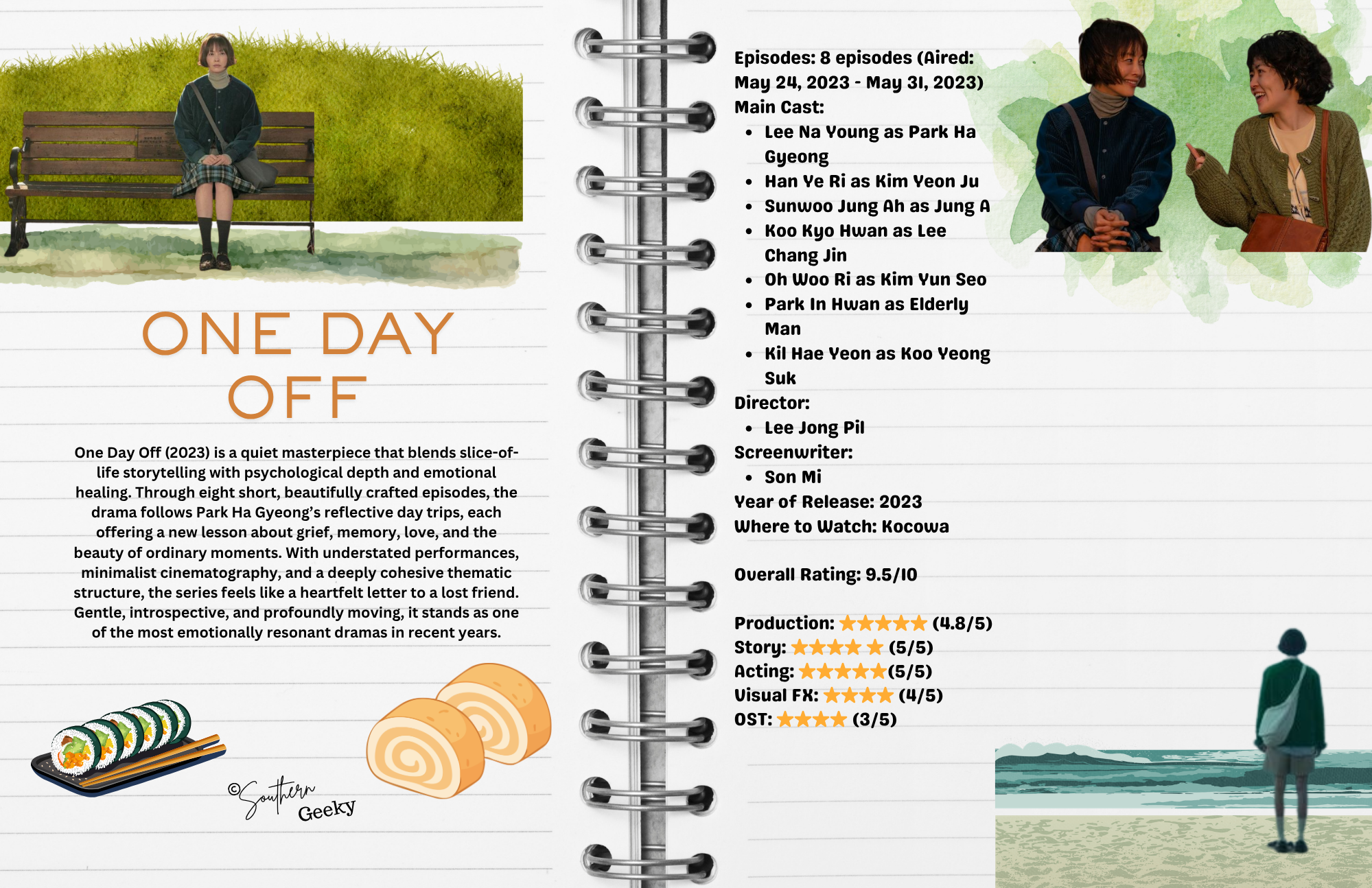
One Day Off (2023) quietly asks this question and answers it with tenderness, introspection, and emotional honesty. In just eight 25-minute episodes, the drama follows high school literature teacher Park Ha Gyeong (Lee Na Young) as she takes simple Saturday trips to escape the monotony of daily life. What unfolds is not a conventional thriller or mystery in the loud, plot-heavy sense, but a deeply psychological and reflective exploration of grief, memory, connection, and the quiet ways we heal.
Story and Themes
One Day Off is structured like a collection of short films stitched together into a thematic quilt. Each episode centers on a different one-day trip, new food, new people, and a new emotional lesson. The episodic storytelling strongly mirrors the contemplative style of many Japanese slice-of-life dramas, where each journey carries a subtle lesson that gently accumulates into a larger emotional payoff.
Episode one’s temple visit sets the tone with themes of silence, nature, and inner stillness. Episode two explores art and the courage to pursue dreams despite fear of rejection. Episode three reflects on the fleetingness of love, while episode four tenderly examines aging parents and the stubbornness that can come with a rapidly changing world. Episode five leans into contingency and the idea that spontaneity leads to meaningful encounters with familiar strangers. Episode six, set against a rainy day, reminds viewers that even disrupted plans can still hold beauty. Episode seven’s bread-centered journey becomes unexpectedly emotional, tying food, memory, and grief together in a heartfelt way.
The final episode serves as a poetic loop in time, revealing why Park Ha Gyeong began these day trips in the first place. Her return to the place of her first adventure with her deceased friend Lee Jin Sol (Shim Eun Kyung) reframes the entire series as an act of remembrance and quiet mourning. In this way, the drama feels less like a travel story and more like a letter to a friend who is no longer there.
Performances
Lee Na Young delivers a profoundly restrained performance as Park Ha Gyeong. She does not rely on dramatic outbursts or exaggerated emotion. Instead, her acting is rooted in subtle facial expressions, pauses, and internal reflection. This understated approach makes her character feel deeply human and relatable, especially for viewers who spend a lot of time in introspection or quiet routines.
Shim Eun Kyung’s role as Lee Jin Sol, though not constantly present, carries emotional weight that echoes across the series. Supporting performances from Han Ye Ri, Koo Kyo Hwan, Kil Hae Yeon, and Park In Hwan add warmth and authenticity to each episode’s encounters. Every guest character feels intentional rather than filler, contributing to the thematic lesson of their respective episode.
The cast collectively creates the feeling of meeting real people on real journeys, not just scripted characters.
Direction and Production
Director Lee Jong Pil and screenwriter Son Mi craft the drama with a minimalist but intentional vision. The cinematography is simplistic yet beautiful, favoring natural lighting, quiet landscapes, cozy food shots, and slow pacing that invites reflection rather than urgency. Each frame feels deliberate, like a visual diary entry.
Production-wise, the 25-minute runtime per episode is one of the drama’s greatest strengths. It never overstays its welcome, and each episode feels complete, almost like a self-contained short film with its own tone and mood. The transitions between episodes create a soft continuity that slowly builds toward the emotional reveal in episode eight.
The atmosphere is gentle, contemplative, and deeply immersive. It does not rely on flashy effects or intense thriller tropes despite its listed genres. Instead, it leans heavily into psychological introspection and emotional realism.
Strengths
One of the biggest strengths of One Day Off is its emotional subtlety. It trusts the audience to sit with silence, small conversations, and everyday moments. The drama also excels in thematic cohesion. Even though each episode has a different adventure, they all connect into a larger narrative about grief, healing, and the quiet act of continuing to live.
Another standout strength is its pacing. The short episode format makes it highly bingeable while still feeling meaningful. Additionally, the food, travel locations, and chance encounters add a comforting slice-of-life charm that enhances the emotional tone rather than distracting from it.
Most importantly, the drama feels personal. It genuinely feels like reading a handwritten letter or flipping through a memory scrapbook.
Weaknesses
One Day Off is so consistent in its tone and structure that it may feel repetitive to some viewers. Because each episode follows a similar rhythm of travel, food, quiet encounters, and reflection, those looking for more variation or narrative escalation might find the format a bit predictable over time.
Additionally, while the short, vignette-style storytelling is one of the drama’s strengths, it can also leave certain side characters or moments feeling fleeting. Some encounters are so compelling that you may wish for a little more time to sit with them before the story moves on to the next journey.
Final Thoughts
This is, without question, one of the best dramas I have watched, not just this year, but since I started watching Asian dramas. Each episode feels like a short film filled with comedy, food, quiet conversations, and gentle emotional revelations. The series does not shout its message. It whispers it. And that whisper lingers long after the final episode ends.
More than anything, One Day Off feels like a love letter to memory, to friendship, and to the small journeys that help us survive ordinary life. It is soothing, introspective, and quietly profound. By the end, it becomes clear that the day trips were never just about escape. They were about healing, remembrance, and learning how to keep living while carrying the memories of those we have lost.
Rating: 9.5/10
Where to Watch: Kocowa
